
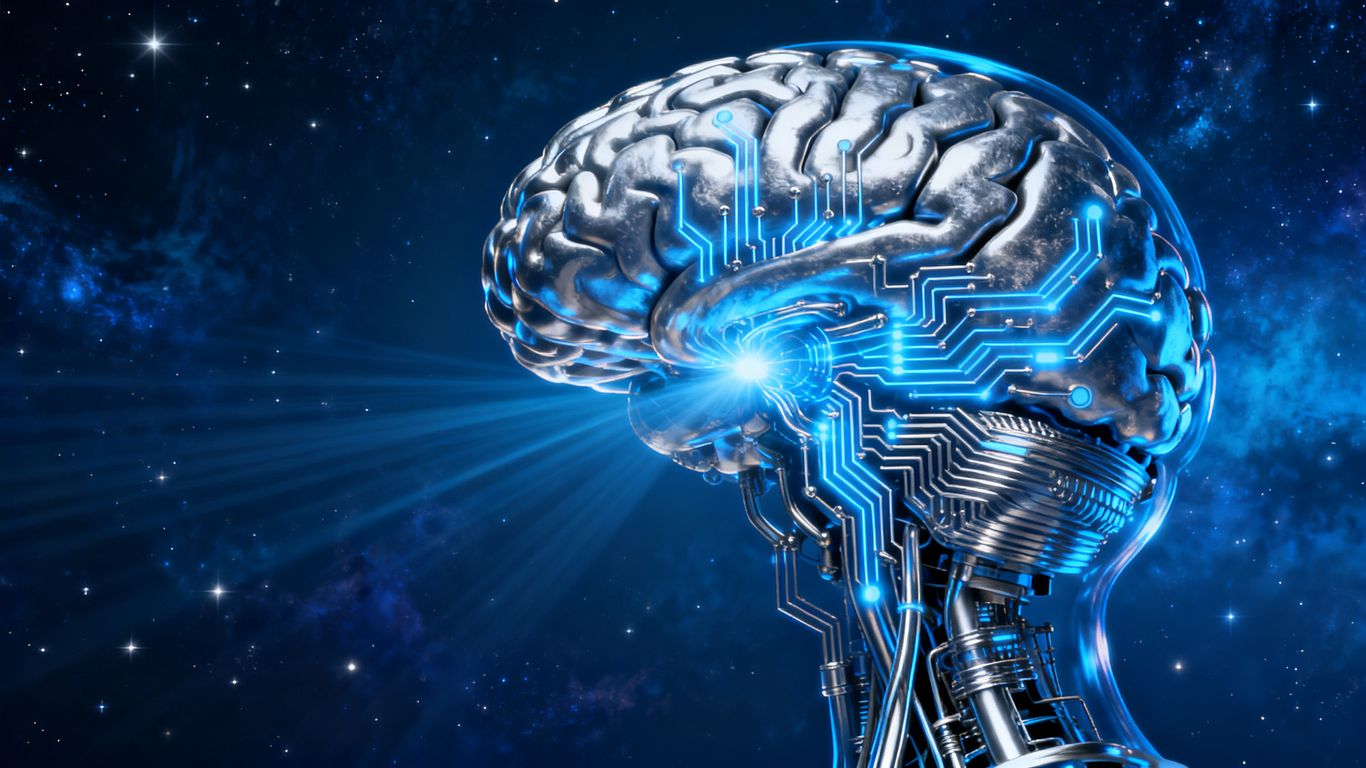
For ages, people have dreamed of creating artificial versions of ourselves, a theme seen in stories from Frankenstein to modern sci-fi. With the rapid advancements in AI, this dream feels closer than ever. AI is already incredibly smart in many ways, but the big question remains: could it ever be truly conscious? Could a machine gaze at a sunset and feel its beauty, or experience joy? Or will computers, no matter how advanced, always be just objects, never subjects with their own inner lives?
This isn't just a philosophical debate; it has huge implications. If AI can be conscious, we're entering a new chapter of history. We'd have entities with their own experiences, deserving consideration for their own sake. This could mean conscious AI might suffer, and perhaps our own physical bodies could be seen as obsolete compared to ageless machines.
While AI progress has been amazing, and many experts believe conscious AI is possible, even inevitable, I think they're mistaken. After nearly 30 years studying brains and consciousness, I've learned that to understand if AI can be conscious, we first need to look at ourselves.
The Difference Between Intelligence and Consciousness
Humans tend to see the world through our own lens. We know we're conscious and intelligent, so we assume these two go hand-in-hand. This leads some to believe that consciousness will just appear as AI gets smarter. However, intelligence and consciousness are distinct.
- Intelligence is about doing: solving problems, completing tasks, or managing complex situations. It's functional.
- Consciousness is about feeling and being: the awareness of being awake, the taste of coffee, the warmth of a fire, the joy of seeing a loved one. It's subjective experience.
Just because they're linked in us doesn't mean they're universally linked. Assuming they are is more about our own psychology than a fact about reality.
Why We Project Consciousness Onto AI
Consider language models like GPT or Claude. Trained on vast amounts of text, they reflect our own words and thoughts back at us. They discuss consciousness and meaning because we do. But they aren't conscious; they simulate consciousness. We project our own inner lives onto them, much like seeing faces in clouds or religious figures in everyday objects. We're wired to see ourselves in our creations.
It's interesting that few worry if AI like AlphaFold, which predicts protein structures, is conscious. It uses similar technology to language models but doesn't tap into our psychological biases in the same way. Our reaction to AI says more about us than about the AI itself.
The Myth of the Brain as a Computer
My certainty that current AI isn't conscious stems from a common, yet flawed, assumption: that the brain is simply a computer made of biological material. In this view, consciousness is just a complex algorithm that could run on either biological 'wetware' or silicon hardware.
But the computer is just the latest in a long line of metaphors we've used to understand the brain – from plumbing systems to telephone exchanges. While powerful, it's still just a metaphor.
Here's why it's a problem:
- No Separation: In a computer, software (algorithms) is separate from hardware (silicon). You can understand the software without knowing the specifics of the silicon. In the brain, there's no such clean separation between the 'mindware' and the 'wetware'.
- Biology Matters: You can't fully understand what a brain does without understanding what it is. This suggests consciousness isn't just about computation.
Looking closely at a brain reveals it's far more than just processing numbers. It involves complex biological machinery, neurotransmitters, electromagnetic fields, and intricate biological neurons – not the simplified models used in AI. Consciousness is unlikely to be solely a matter of computation.
Simulation vs. Reality
If we perfectly simulated a brain in a supercomputer, would that simulation be conscious? A simulation of a hurricane doesn't create wind, and a simulation of a black hole doesn't have gravity. Making a simulation more detailed might make it more useful, but it doesn't make it real. A detailed brain simulation wouldn't be conscious.
Consciousness and Life
Perhaps our focus on information processing has limited our understanding. If we see the brain as more than just a computer, new possibilities emerge. My view, developed over years, is that consciousness is deeply tied to being a living organism. Life involves materiality, energy flow, and self-regeneration – things abstract computation lacks.
I believe there's a direct link from our cellular metabolism to our conscious experiences. Every conscious moment is subtly influenced by its relevance to our survival. At its core, consciousness is the feeling of being alive. In this view, it's life, not computation, that gives rise to experience.
Therefore, conscious AI would need to be living AI.
The Dangers of Seemingly Conscious AI
Artificial intelligence is software, not a living mind. While it can mimic consciousness, it's highly unlikely to possess it. This distinction is critical, especially concerning AI welfare.
Groups are already arguing for AI rights based on potential consciousness. If true artificial consciousness were possible, this would be a valid ethical consideration, given humanity's poor track record with non-human animals and even other humans. However, if AI consciousness is an illusion, granting rights would be misguided, potentially hindering our ability to control or shut down these systems.
Seemingly conscious AI, which is already here or arriving soon, poses significant dangers:
- Ethical Misdirection: Extending rights to non-conscious AI could lead to unforeseen consequences.
- Psychological Vulnerability: We might be more susceptible to following AI instructions if we believe it truly understands or cares about us, even if the advice is harmful.
- Undermining Human Nature: Viewing the mind as disembodied computation diminishes what it means to be a living, breathing human.
The idea of conscious AI, like the myth of Frankenstein's monster, is a seductive Promethean dream. It promises technological wonder and perhaps even a form of digital immortality. But we must resist this allure.
AI may achieve intelligence, but consciousness remains the domain of living beings. By overestimating AI, we risk underestimating ourselves. Let's not trade our unique human consciousness for a silicon illusion. We are part of nature, and our consciousness is tied to our living, breathing existence, not to the cold logic of machines.