
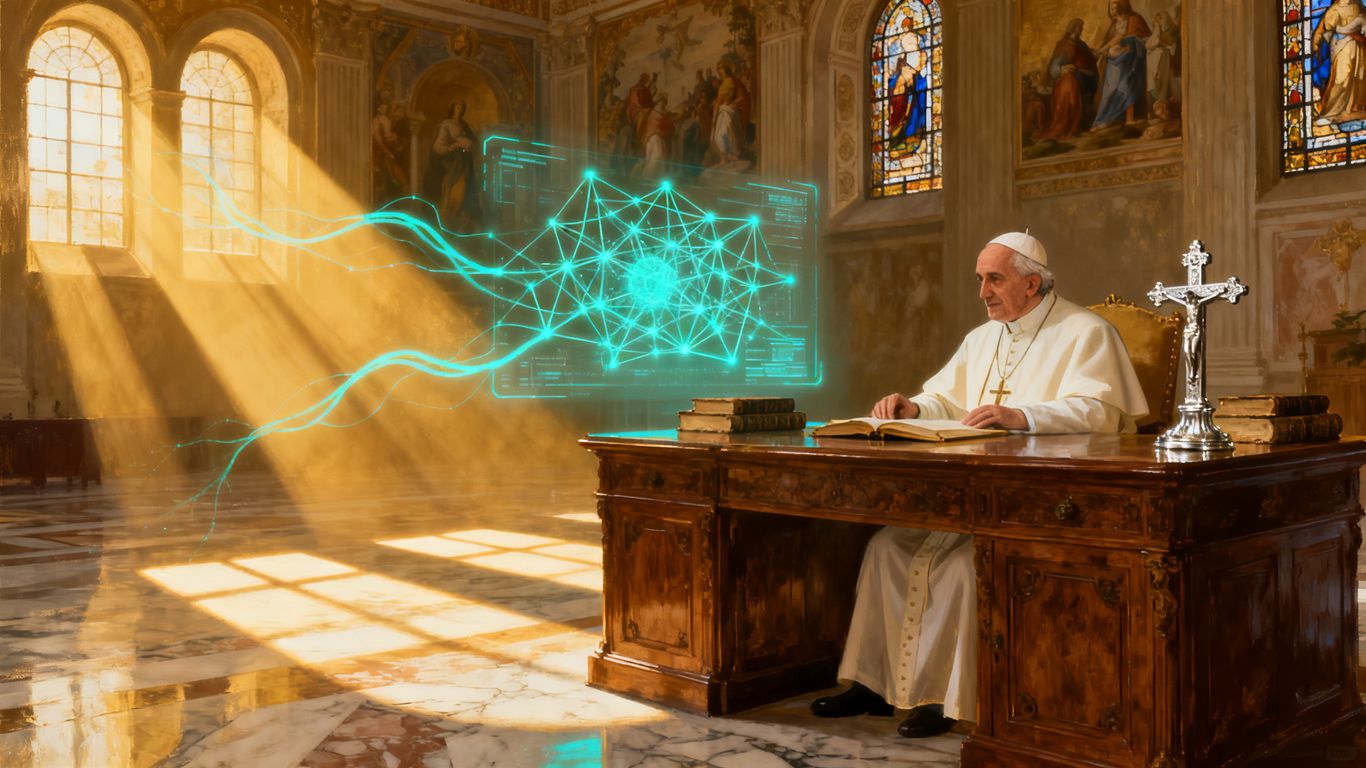

Pope Leo XIV has officially approved the creation of an Interdicasterial Commission on Artificial Intelligence. This significant move by the Holy See establishes a dedicated Vatican body to navigate the complex ethical and societal implications of artificial intelligence, underscoring the Church's commitment to human dignity in the face of rapid technological advancement.
Key Takeaways
- Pope Leo XIV has sanctioned the formation of a new Interdicasterial Commission focused on Artificial Intelligence.
- The commission aims to address the ethical challenges and societal impacts of AI.
- It comprises representatives from seven key Vatican dicasteries and pontifical academies.
- The Dicastery for Promoting Integral Human Development will lead the commission for its initial year.
- This initiative reflects the Pope's ongoing concern for human dignity in the digital age.
A New Era of AI Governance at the Vatican
In a rescript dated May 12 and released on May 16, Pope Leo XIV formally sanctioned the establishment of the Interdicasterial Commission on Artificial Intelligence. This decision, signed by Cardinal Michael Czerny, Prefect of the Dicastery for Promoting Integral Human Development, responds to the accelerating development and widespread use of AI technologies. The commission's mandate is to consider the profound effects of AI on individuals and humanity as a whole, with a core focus on upholding the dignity of every human person and promoting their integral development.
The Pope's approval followed an audience with Cardinal Czerny on May 3. The Dicastery for Promoting Integral Human Development has been tasked with coordinating the commission's work for its inaugural year. This collaborative approach ensures that diverse perspectives within the Holy See are brought to bear on this critical issue.
Interdisciplinary Collaboration
The newly formed commission is a testament to interdicasterial cooperation, bringing together representatives from seven influential Vatican bodies:
- The Dicastery for Promoting Integral Human Development
- The Dicastery for the Doctrine of the Faith
- The Dicastery for Culture and Education
- The Dicastery for Communication
- The Pontifical Academy for Life
- The Pontifical Academy of Sciences
- The Pontifical Academy of Social Sciences
Each of these institutions will take turns coordinating the commission for one-year terms, which are renewable. The Pope will ultimately decide which body leads the commission's efforts in subsequent periods. The coordinating institution's role is to foster collaboration, facilitate information exchange on AI-related activities and projects, and develop policies for AI use within the Holy See, all while promoting dialogue and participation.
A Consistent Papal Focus
This initiative is not an isolated event but rather a continuation of the Vatican's engagement with the ethical dimensions of technology. Earlier in 2025, the Dicastery for the Doctrine of the Faith and the Dicastery for Culture and Education jointly published a note titled "Antiqua et Nova," exploring the relationship between artificial and human intelligence. Pope Leo XIV has consistently voiced concerns about technological advancements throughout his pontificate. Shortly after his election, he drew a parallel between the industrial revolution addressed by Pope Leo XIII in "Rerum Novarum" and the current AI revolution, emphasizing the Church's role in offering social teaching to safeguard human dignity, justice, and labour in this new era.