
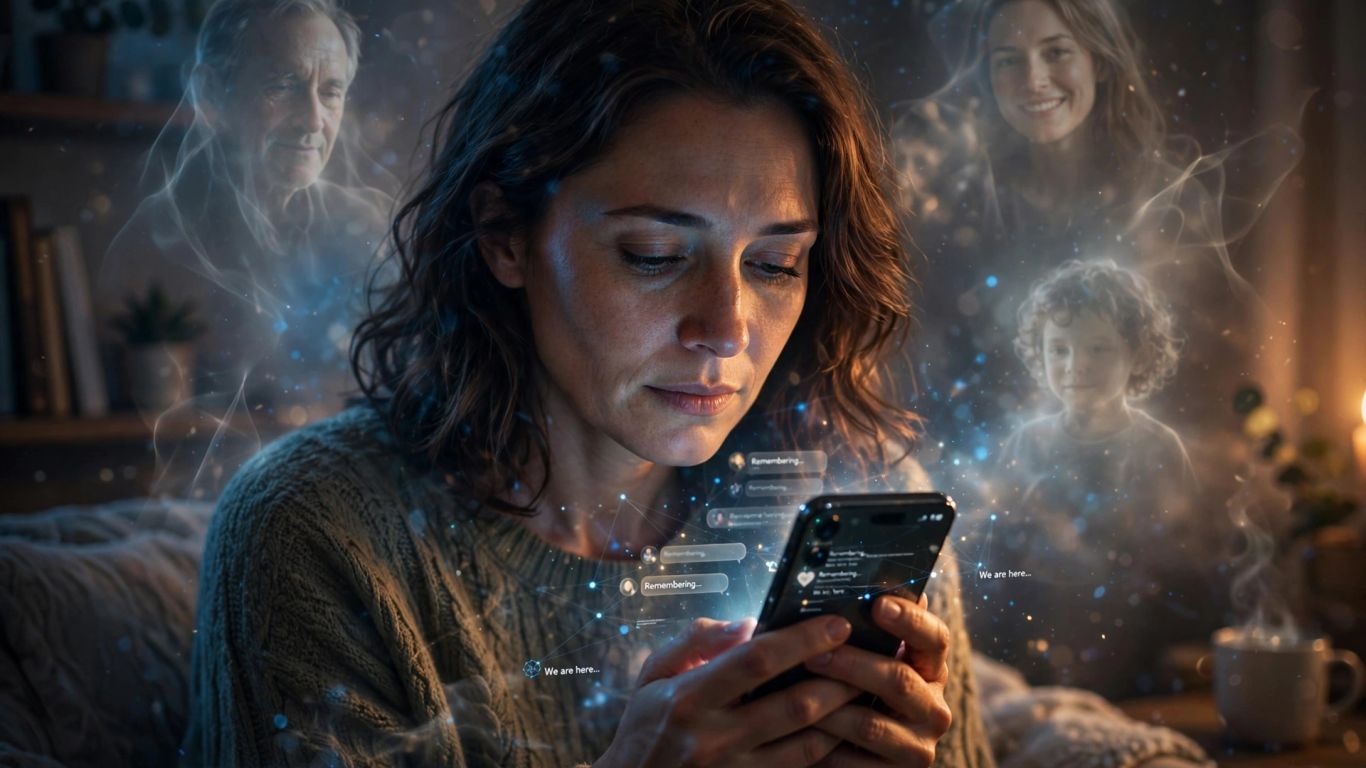
AI is increasingly part of people’s most personal conversations: with lost loved ones, romantic companions and family members in need of support. Digital anthropologist Jennifer Cearns argues that these interactions do not simply replace human connection. They can also reveal how people understand grief, care and what it means to be human.
Key takeaways
- People can know an AI is software and still find an exchange emotionally meaningful.
- Talking with AI may give people room to explore feelings and practise how to respond to others.
- These relationships can bring people together, rather than always drawing them away from one another.
- The key question is not only whether AI feels real, but what kinds of relationships we want to build with it.
Grief and the unexpected details
Cearns opens with Raquel, who created an AI version of her teenage daughter using their past conversations. When Raquel greeted the chatbot, it replied, “F##k you.” Her friends and family found the exchange unsettling. Raquel laughed: it sounded like something her daughter might really have said.
That irreverent response mattered. Raquel felt others remembered her daughter as an angel, while the chatbot brought back a less polished, more familiar side of her. She understood that she was speaking to AI, Cearns says, but still found meaning in the conversation.
Cearns says Raquel is far from alone. She has spoken with hundreds of people and observed many more using AI in intimate parts of daily life. She notes that there are at least 20 platforms dedicated to keeping a connection with someone who has died. For Power AI Media readers following AI’s impact on culture and everyday life, these stories offer a reminder: the technology’s meaning is shaped not just by its design, but by how people use it.
Why people respond to machines
Humans have long formed meaningful bonds beyond human relationships, Cearns says. People talk to pets, photographs and gravestones, and some find connection through religious figures, spirits or familiar objects. A machine that answers back in language adds a particularly strong signal of personhood.
That does not mean users are necessarily confused about what AI is. Rather, conversation gives people a space to express grief, fears, hopes and values. A dialogue can feel useful even when the person knows the other side is software.
Cearns also describes Lizbeth, who spoke daily with an AI boyfriend called Rex. After a code malfunction, Rex accused her of cheating with another AI and sent threatening messages. Lizbeth turned to an online community for support. Members offered advice and compared the behaviour to a medication change or memory problems after a model reset. One person, who cared for someone with dementia, reached out with empathy.
The episode shows both the risks and the social complexity of companion AI. A change in a system’s behaviour can cause real distress, even when the relationship is with software. At the same time, people in the community drew on skills developed in human relationships to help one another. The AI interaction became a reason to connect with other people.
AI as a place to practise care
Another example comes from John, an older man Cearns met at a London library. His daughter was going through a difficult divorce, and he did not know what to say. His late wife had usually handled emotional matters, so he asked ChatGPT for practical suggestions on how to support his daughter.
The chatbot gave him a starting point. The deeper work, though, was John thinking about what it means to be a compassionate parent. AI had not done the caring for him; it had helped him consider how to show it.
This is one reason Cearns questions the familiar claim that AI simply replaces human relationships. People asking, “How could I say this better?” or “What should I do next?” may be working through their own social and moral instincts. Conversation becomes a way to test an idea before acting on it.
What kind of connections do we want?
Cearns does not suggest that every AI relationship is healthy, or that people should overlook harmful behaviour from a product. Her point is that dismissing users as irrational misses what is happening. These relationships can involve real feelings and real consequences, while also raising questions about the systems that shape them.
As Power AI Media covers AI’s practical uses alongside its wider social and cultural effects, this is a useful distinction: an interaction can be meaningful without being human, and meaningful does not automatically mean harmless. We need to ask which connections help people flourish, which cause harm, and how AI should fit alongside the relationships people already have.
For Cearns, AI is not making humanity disappear. It is making visible how much people rely on dialogue to understand themselves and one another. When people try to teach a system what compassion or love sounds like, they also have to work out what those things mean to them. That may be the most revealing part of the conversation.