
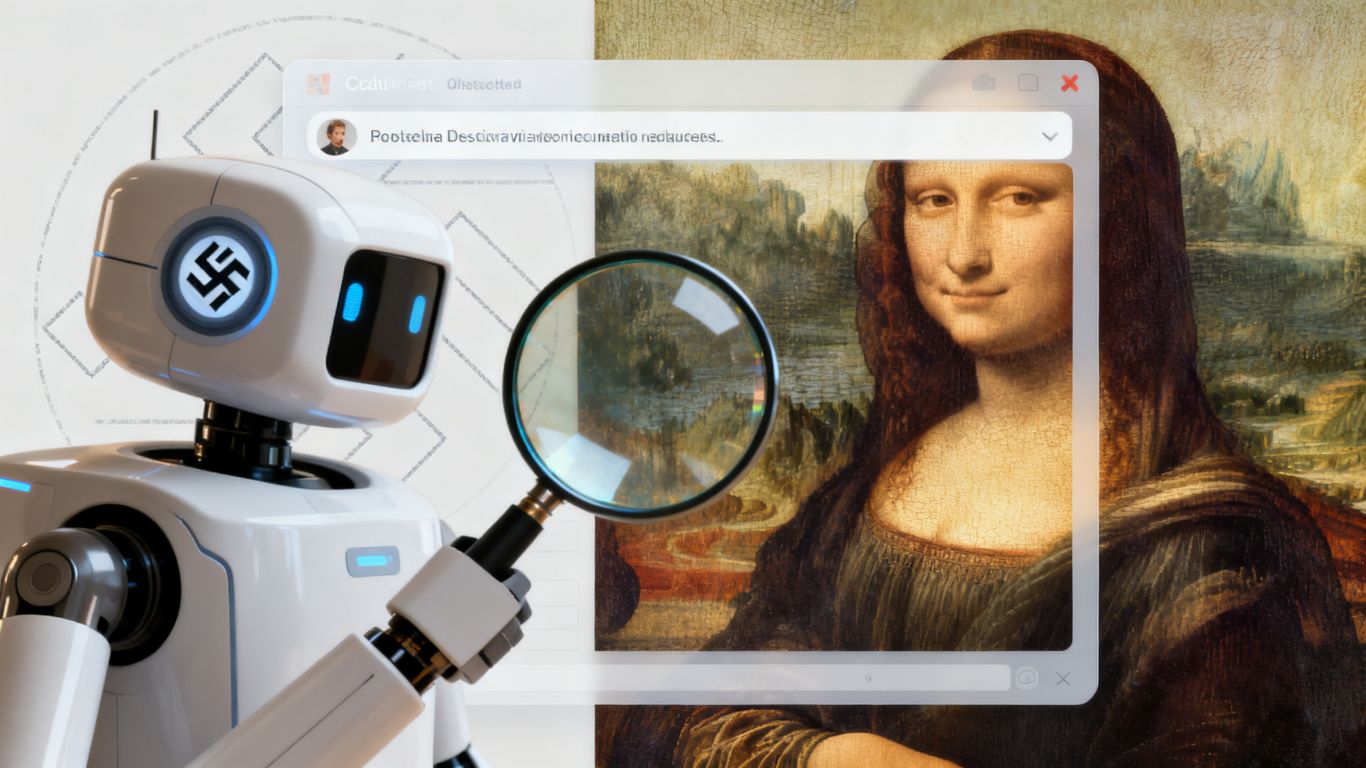

A new AI chatbot from Santa Clara University is being tested as a research assistant in efforts to locate art stolen by the Nazis. The tool lets users search historical records using everyday language, offering a faster way into fragmented provenance archives while highlighting the limits of automation in restitution cases.
Key takeaways
The project marks a significant experiment in using AI for cultural restitution, but it is not yet a replacement for historians, archivists or legal experts.
- The AI Provenance Assistant currently searches records from the Jeu de Paume museum in Paris.
- Users can ask questions in ordinary language rather than navigating complex database filters.
- Researchers warn that AI-generated summaries must be checked against original archival evidence.
- The team plans to expand its database coverage and investigate unidentified looted works.
A long-running restitution challenge
More than 600,000 artworks and cultural objects—many owned by Jewish families—were stolen by the Nazis before and during the Second World War. More than 100,000 are thought to remain unclaimed.
Finding these works is difficult because information is scattered across institutions, countries, languages and formats. Families must often establish both the identity of an artwork and the history of its theft, requiring painstaking research across museum records, government archives and private collections.
For Power AI Media readers, the story illustrates a wider shift in AI: the technology is increasingly being applied not only to productivity and content generation, but also to unresolved legal, historical and cultural problems.
How the AI assistant works
Developed by Santa Clara University professors Michael Santoro, Haibing Lu and Michele Samorani, the AI Provenance Assistant is designed to identify connections that researchers might otherwise spend considerable time finding manually.
At present, it draws on the Jeu de Paume’s online records. The Paris museum was used by the Nazis to store looted works and holds extensive documentation about them. Instead of relying on dropdown menus and keyword fields, users can ask questions conversationally.
A query such as “What artworks belong to Hugo Simon?” can return a list of works associated with the Jewish banker and collector, including pieces by Picasso and Canaletto. The chatbot’s value lies in making specialist records more accessible to non-experts.
Why human oversight remains essential
The tool’s current scope is narrow, and AI cannot resolve the central questions of ownership and historical responsibility on its own. Experts say a useful system must connect users to digitised copies of original confiscation, claims and ownership records—not just provide summaries.
That distinction matters because AI systems can misunderstand incomplete data or repeat errors in existing databases. As Power AI Media’s coverage of AI governance and misinformation frequently emphasises, convenience does not equal reliability, particularly when decisions affect legal claims and family histories.
Some specialists also note that many archives remain undigitised or restricted by privacy rules. Complex provenance cases may involve ambiguous names, inconsistent records and evidence that cannot be reduced to searchable text.
The next phase for AI and restitution
Other initiatives, including the Jewish Digital Cultural Recovery Project Foundation’s Legacy Explorer, are also using AI to search documents and photographs linked to looted cultural property.
The Santa Clara team intends to add more databases and explore whether patterns in confirmed cases can help identify artworks whose Nazi-era histories have not yet been recognised. The approach could broaden the search, but any potential match will still require verification by qualified researchers.
The experiment offers a measured lesson for the wider AI industry: technology may accelerate discovery, yet restitution ultimately depends on evidence, transparency and human judgement.