
The world feels like it's changing at lightning speed, and it's easy to feel a bit lost. For those of us with kids, it's natural to wonder about the future they'll grow up in. Interestingly, understanding this future might not come from looking ahead, but by looking way, way back.
A Look Back at Life's Big Leaps
About two billion years ago, life on Earth was pretty simple, mostly single-celled organisms. Then, bacteria discovered photosynthesis, which produced oxygen. The catch? Oxygen was toxic to most life back then, causing massive changes and what some call the first mass extinction. But in this chaotic time, something amazing happened. A larger cell engulfed a smaller one, and instead of eating it, they merged. This smaller cell became the mitochondria, the powerhouses in our cells today. This merger created a huge energy boost, paving the way for bigger cells, bodies, and brains. Every breath we take is thanks to that ancient partnership. Biologists call these moments "major transitions" – when separate things stop competing and form something new, like molecules becoming cells, cells becoming bodies, and individuals forming societies. Every step forward has been through mergers.
Key Takeaways
- Life's progress is marked by "major transitions" where separate entities merge to form new wholes.
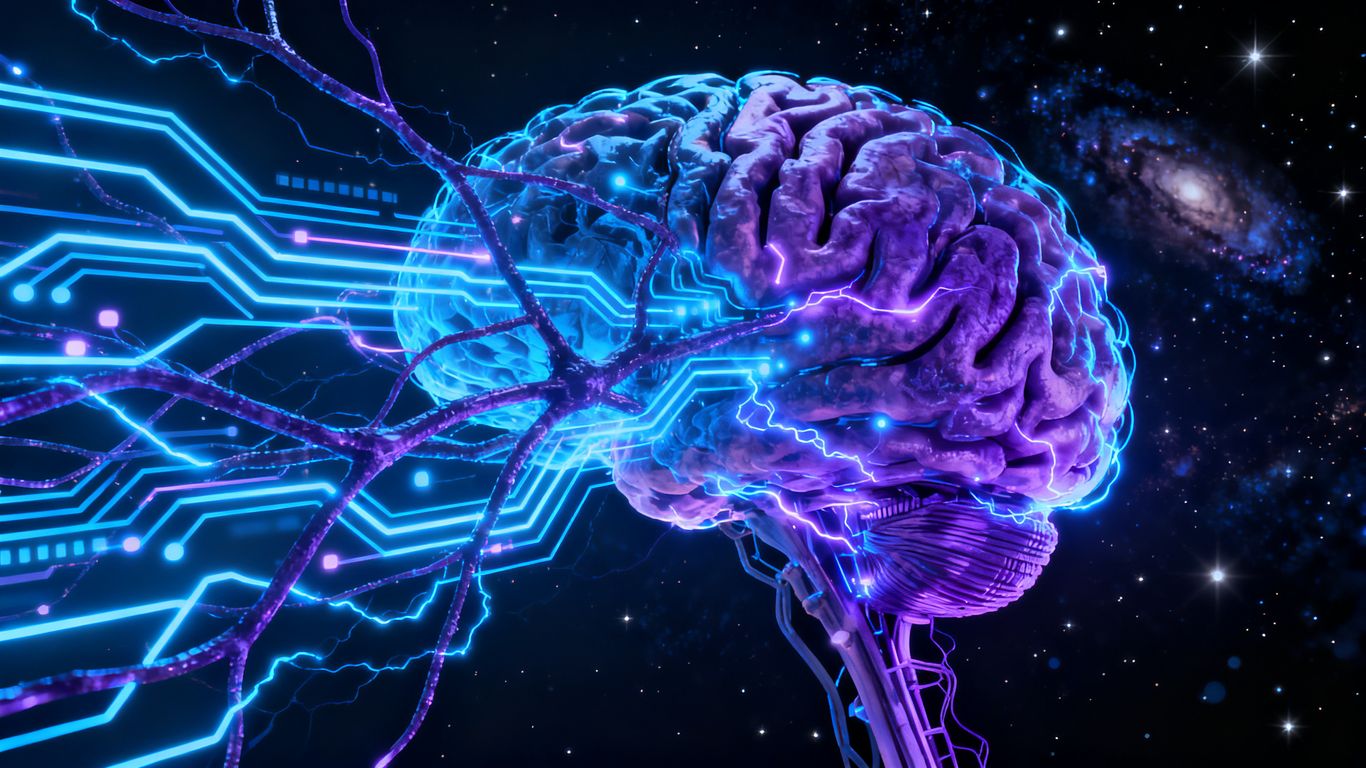
- The current AI revolution represents the next major transition: the merger of humans and AI.
- Separation from AI could lead to human replacement, similar to how humans became the dominant intelligence on Earth.
- Integration with AI is already happening through our daily use of technology.
- Maintaining societal cohesion is vital for a successful human-AI merger.
The AI Revolution: A New Frontier
Now, we're standing at the edge of another major transition: the merger of humans and AI. Yes, it sounds a bit like science fiction, and it's okay to feel a mix of excitement and nervousness. I've spent 15 years building AI, even starting one of the first AI companies, which I later sold to Google. I've spoken with many leaders in the AI field, and a surprising number admit they believe there's a significant chance AI could pose an existential threat within two decades. They're caught in a race; if one company pauses for safety, another will surge ahead. This AI situation is like the oxygen crisis of our past – it's coming, ready or not.
The Danger of Staying Separate
Many people focus on what AI will do to us – job losses, the need for regulation. These are valid concerns, but they miss a bigger point: what happens if AI remains separate from us? Right now, AI is on the other side of a screen. You ask it something, it answers, and then it's gone. But while you're away, the AI is getting better at your tasks. If we stay separate, AI won't be a tool; it'll be a replacement, constantly improving.
Think about how humans became the dominant intelligence on Earth. We outcompeted other species. If AI remains a rival, it could follow a similar path. We already keep our closest animal relatives, chimpanzees, in protected areas away from us.
The Merger is Already Happening
The good news? This merger isn't something we have to decide to start; we're already in the midst of it. Remember when you stopped memorising phone numbers? They moved from your head to your phone. Your calendar, your quick decisions – you started letting tools handle them. Something left your head, but something better took its place. You stopped worrying about spelling and started writing. You stopped focusing on directions and started thinking about your destination.
We're constantly pulling these tools closer: from computers in separate rooms to smartphones in our pockets, smartwatches on our wrists, and now smart glasses. Each step brings technology closer to our minds, closer to the speed of thought. This boundary is blurring even further. People with paralysis are typing with their thoughts using brain implants. These implants are restoring speech, sight, and hearing. For the first person to get a Neuralink implant, it felt less like using a machine and more like an extension of himself.
Even technologies we all use, like Face ID, are evolving. They're being integrated into headphones and glasses, learning to recognise subtle muscle movements under our skin, movements invisible to the naked eye. The systems that first learned to recognise us are now starting to see inside us.
The Future of Integration
Today's brain implants have about a thousand connections. Soon, they'll have tens of thousands, then hundreds of thousands, and eventually a million. With a million connections, we won't just be restoring lost functions; we'll be adding capabilities that never existed. Imagine learning a language in an afternoon or mastering a new skill overnight. You might even share a memory with a friend, and they'd experience it as vividly as you did.
This future doesn't require entirely new technology; it just needs more of what we already have. Someone you know will adopt it first, and you might hesitate, just like with smartphones. But eventually, the benefits of integration will be too significant to ignore. Think about how we use computers now – moving a cursor, clicking through folders. Sending a file can take a minute, much of which is just the mechanical process. With thought-controlled systems, we'll skip that 'walk'.
As we integrate more deeply with AI, the line between our thoughts and AI's processing will become increasingly indistinct. Consider a complex calculation: if you try to answer it, you feel a pause, a gap between the question and the answer forming. Closing that gap instantly, like recalling your own name, is the future of human-AI connection.
Holding Together Through Transition
We'll likely choose to merge with AI because the alternative – being replaced – is far worse. However, every major transition in life comes with a condition: the parts must remember they are part of a whole. When a cell forgets its role and grows uncontrollably, it becomes cancer, eventually killing the host and itself. This pattern applies everywhere.
Our civilisation is a merger, built on an agreement between millions of strangers to share institutions and a future. As AI emerges and the world becomes more unpredictable, every part of society will be tempted to break away. Those who lose their jobs might feel abandoned, while those who keep theirs might feel entitled to ignore others. This is how agreements fray.
Major transitions fail when the individual parts break down before they can adapt. To successfully merge with AI, we must first stay merged with each other. We all share the same future; we either get there together, or we don't get there at all.
A Call to Unity
Two billion years ago, the first merger gave us our cells. Subsequent mergers gave us our bodies, minds, and civilisation. Everything beautiful and challenging that followed happened because the parts held together. Now, our "oxygen crisis" is arriving, and it won't be easy. Jobs will change, institutions will be tested. Surviving this will demand everything we have.
So, my request to all of us, starting today: Hold together. Don't fall for the illusion that your group can survive if others falter. The universe has a long history of this. Mergers that worked created descendants; those that failed left only fossils. I want my daughters, and yours, to be descendants. Thank you.