
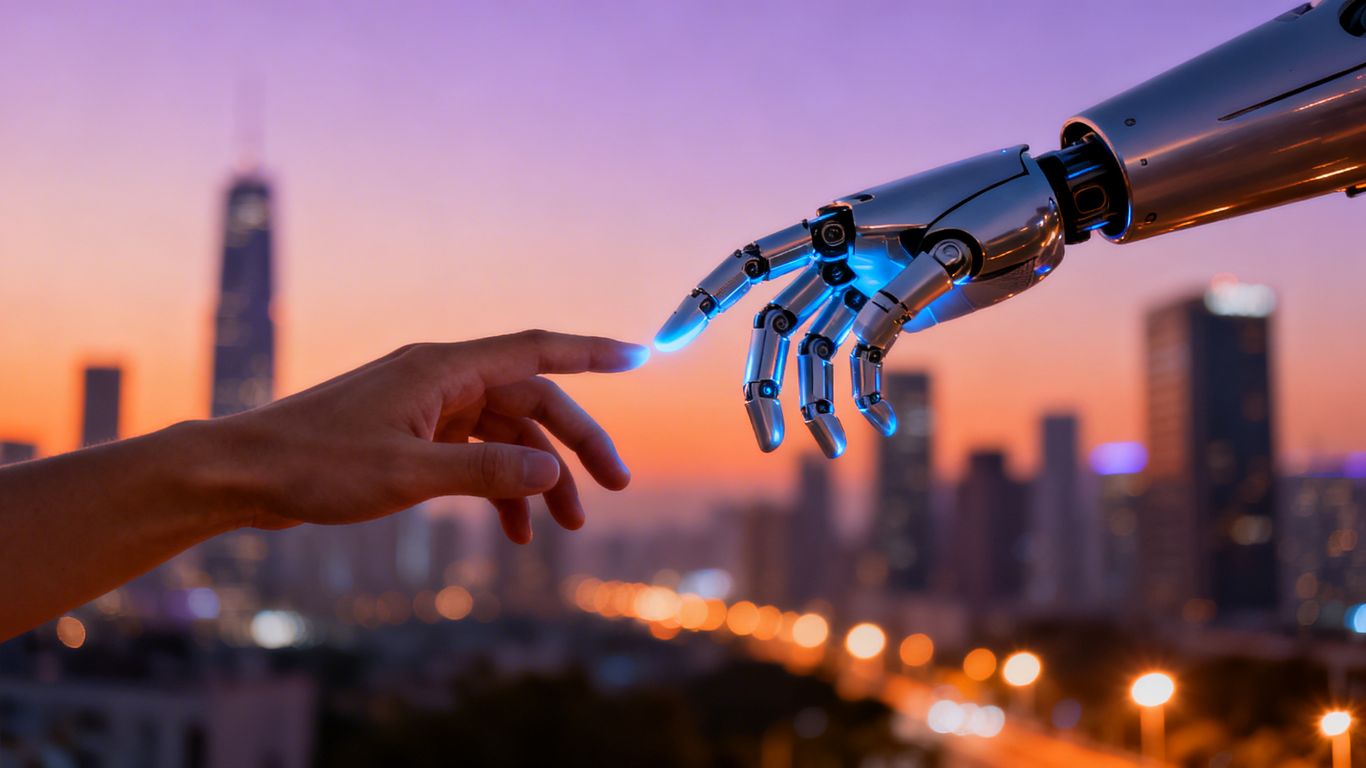
The conversation around Artificial Intelligence often circles back to whether or not AI will replace human jobs. But what if we're asking the wrong question? Leadership expert Vinciane Beauchene suggests that the real focus should be on how humans can make their unique contributions count in an increasingly automated world. She challenges common assumptions about AI's impact on the workplace and offers a blueprint for leaders to create environments where people can focus on what truly matters.
Key Takeaways
- The Turing test, focused on conversation, is outdated; doing is what changes the world.
- AI agents are becoming highly autonomous, capable of complex tasks with minimal oversight.
- Human value in the workplace is shifting, not disappearing, moving towards relationship building and loyalty.
- We need to move beyond the idea of AI simply augmenting humans and prepare for a future where AI takes on many tasks.
- "Soft skills" like empathy are not a guaranteed human advantage as AI improves.
- Protecting jobs is less effective than investing in human potential and adaptability.
- Organisations need to fundamentally rethink their structures and training to prepare for AI.
Rethinking Intelligence: Beyond the Turing Test
Back in the 1950s, Alan Turing proposed a test: if a machine could converse so well that you couldn't tell it apart from a human, it must be intelligent. Today, most chatbots can pass this test with flying colours. However, Vinciane Beauchene argues that this test is fundamentally flawed. "Talking isn't what's going to change the world. Doing is," she states. This leads to a more pertinent question for leaders: "If an AI could take over all of your team's tasks, who would you keep and why?"
This question is strategic, especially for those with young children, like Beauchene herself, who wonder about the future world of work their daughters will enter. The goal is to build a future where humans matter more, not less.
AI Agents and the Shifting Landscape of Sales
A compelling example comes from a consumer goods company looking to overhaul its sales process with AI. They weren't just deploying another algorithm; they were rethinking the entire sales cycle using AI agents. These agents are the next generation of AI – autonomous, able to connect systems, plan, act, learn, and adapt. In sales, this means an AI could potentially target customers, make recommendations, negotiate, and close deals without any human input.
However, a crucial question arose: "If the machine does all of this, then what remains for humans?" Digging deeper, the company discovered that their most loyal customers weren't staying for the products or prices, but for the feeling the sales representatives gave them. This insight flipped the model. Humans would shift from pushing products to building relationships, fostering belonging, and cultivating loyalty. This required new skills, incentives, and a completely different mindset, ultimately transforming the business.
Three Myths Holding Us Back
Beauchene identifies three common beliefs that hinder our preparation for an AI-driven future:
- "All of this is overblown. We'll adapt." While humanity has adapted to past revolutions like electricity and the internet, it was often on the back of generations with time and training. Today, time is short. Technology moves exponentially, while humans move linearly. Companies that don't prepare now will struggle to keep up. This isn't about speculative Artificial General Intelligence (AGI), but about Artificial Capable Intelligence (ACI) – AI that can handle complex goals with minimal oversight, which is already a reality.
- "Soft skills are our sweet spot." The idea that empathy and creativity are uniquely human is comforting, but evidence suggests otherwise. People increasingly find interactions with AI more empathic because AI doesn't get tired, cranky, or judgmental. The unique human advantage isn't a fixed list of "soft skills" but something each company must define based on its strategic goals.
- "We need to protect jobs." While 41% of employees fear their jobs will vanish due to AI, protecting jobs is like anchoring a boat in a storm. Jobs are static, but human potential is not. The focus should be on investing in this potential. However, current organisational structures – static org charts, narrow career paths, and infrequent training – are not equipped for this.
Designing for Human Impact in the Age of AI
So, what should organisations do? The most forward-thinking companies start with strategy, not technology. They identify their core differentiating outcomes and then figure out how AI agents can help achieve them in new ways, pinpointing where humans still add significant value.
This requires a radical, AI-first reinvention, not just incremental changes. It involves:
- Strategic Visioning: Conducting workshops to understand how AI will disrupt different business areas and aligning on a vision where AI and humans work best together.
- Workforce Modelling: Developing multi-year skills forecasts to determine the number of people needed and the specific skills they require, moving beyond guesswork.
- Talent Development: Reinventing roles and creating effective upskilling and mobility engines. For example, transforming researchers from solo chemists to data-driven biologists and multifunctional team members.
- Committing to Talent: Investing systematically in all talent, not just tech roles, and protecting time for learning. While freelancers dedicate hours to learning, employees often spend none.
The future isn't about being more human in a fallback sense; it's about building systems that allow humans to do what matters most. It's a story of human differentiation. AI will continue to advance, but how we advance with it is up to us. The question isn't whether humans will have jobs, but what we want humans to be best at. In the age of AI, being human is not a fallback; it's a practice to be made exceptional.